
A team of physicists from the Institute of Modern Physics (IMP) of the Chinese Academy of Sciences, together with collaborators, has identified the dominant physical mechanism responsible for energy release in the nuclear isomer molybdenum-93m (Mo-93m).
Using high-precision experiments, the researchers showed that inelastic nuclear scattering—rather than the long-hypothesized nuclear excitation by electron capture (NEEC)—is the primary driver of isomer depletion under their experimental conditions.
The findings, published as an Editors' Suggestion in Physical Review Letters on February 6, provide crucial experimental evidence concerning a long-debated process and shed new light on the controlled release of nuclear energy.
Atomic nuclei can exist in different energy states. Long-lived excited states, known as nuclear isomers, store large amounts of energy and hold great potential for applications such as nuclear batteries, gamma-ray lasers, and ultra-precise nuclear clocks. However, triggering their energy release rapidly and on demand remains a major challenge for practical applications.
Among known isomers, the nuclear isomer Mo-93m is considered a promising candidate for high-energy-density storage. Earlier studies suggested that NEEC might efficiently trigger energy release from Mo-93m. "However, subsequent theoretical and experimental studies cast doubt on whether this mechanism plays a dominant role," said Prof. GUO Song from IMP, corresponding author of the study.
To address this question, the researchers prepared a purified, high-energy beam of Mo-93m ions using the radioactive ion beam line at the Heavy Ion Research Facility in Lanzhou (HIRFL). They also developed a low-background, high-sensitivity experimental method to measure the isomer depletion of Mo-93m.
After precise purification, the Mo-93m ions were implanted into a detector covered with either lead foil or carbon foil. By capturing characteristic gamma rays, the researchers precisely measured the depletion probability of Mo-93m ions during the slowing-down processes. The probability was approximately 2 in 100,000 for lead foil and 5 in 1,000,000 for carbon foil.
These results demonstrate high consistency with theoretical calculations for inelastic nuclear scattering but are significantly higher than those predicted for NEEC under the current conditions.
"This indicates that the observed isomer depletion in Mo-93m is dominated by inelastic nuclear scattering, rather than the previously proposed NEEC mechanism," said Dr. DING Bing of IMP, the study's first author.
This study not only clarifies the debate around the energy-release mechanism of Mo-93m but also provides reliable experimental data for understanding the behavior of nuclear isomers in plasma, astrophysical environments, and even inertial confinement fusion.
According to Prof. ZHOU Xiaohong from IMP, another corresponding author, NEEC remains a promising method for triggering energy release from nuclear isomers. However, future attempts to observe NEEC may require optimized environments, such as plasma or electron-ion beam collisions.
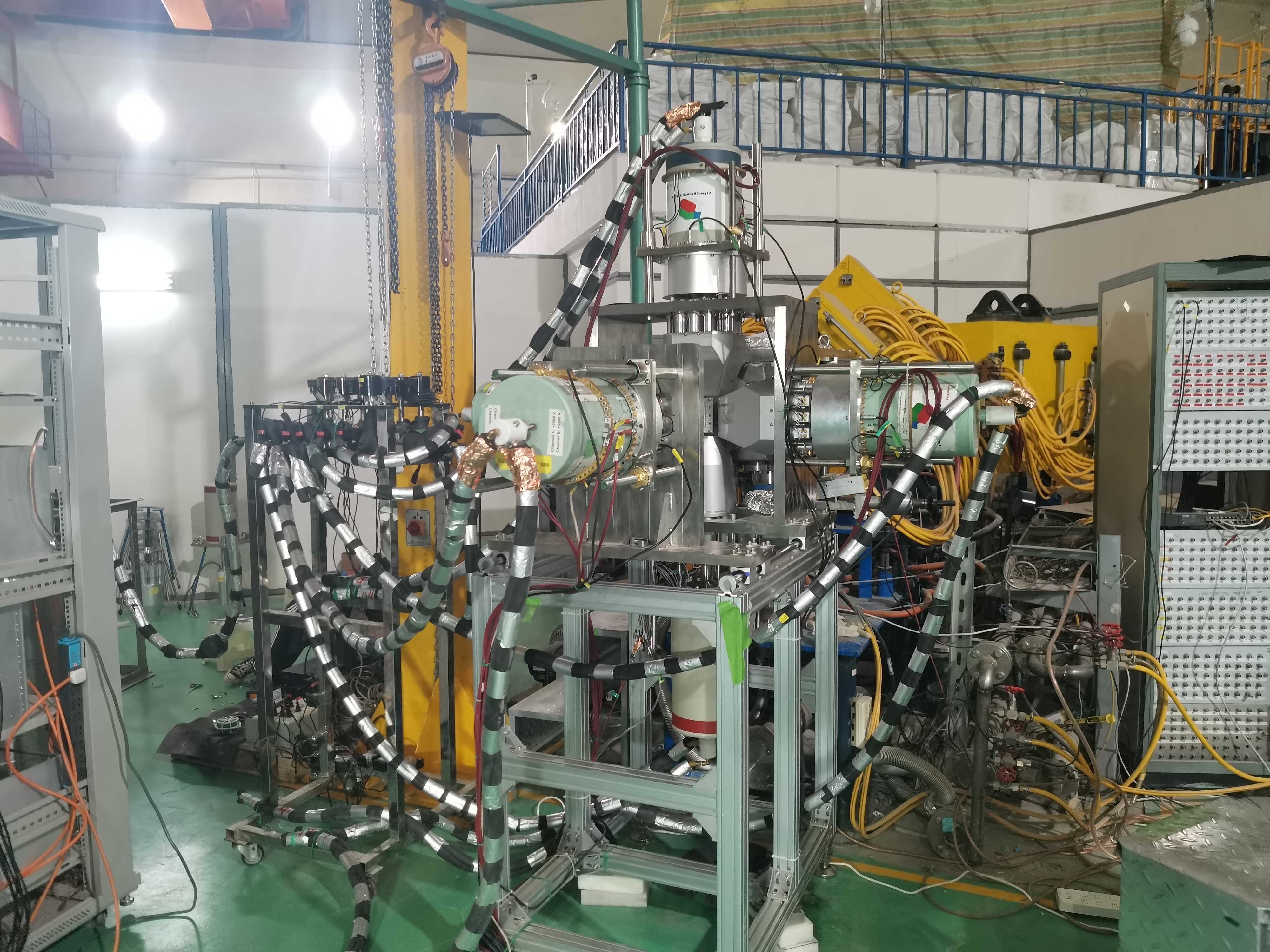
The high-purity germanium detector array. (Image from IMP)
Recently, CAS-DOE (U.S Department of Energy) Nuclear Energy Sciences and Technology 3rd Executive Committee Meeting was held in Shanghai. The two parties will strengthen the cooperation by several working groups focusing on Molten Salt Coolant Systems, Fuel Resources and ...

Chinese scientists have made a technological breakthrough in the country's nuclear energy program. The new accelerator-driven system (ADS) is able to raise the utilization rate of uranium to 95 percent, a great leap forward from less than 1 percent using the current techn...

86-10-68597521 (day)
86-10-68597289 (night)

52 Sanlihe Rd., Xicheng District,
Beijing, China (100864)
Copyright © 2002 - Chinese Academy of Sciences


